


Preparing for Fall Football Practice
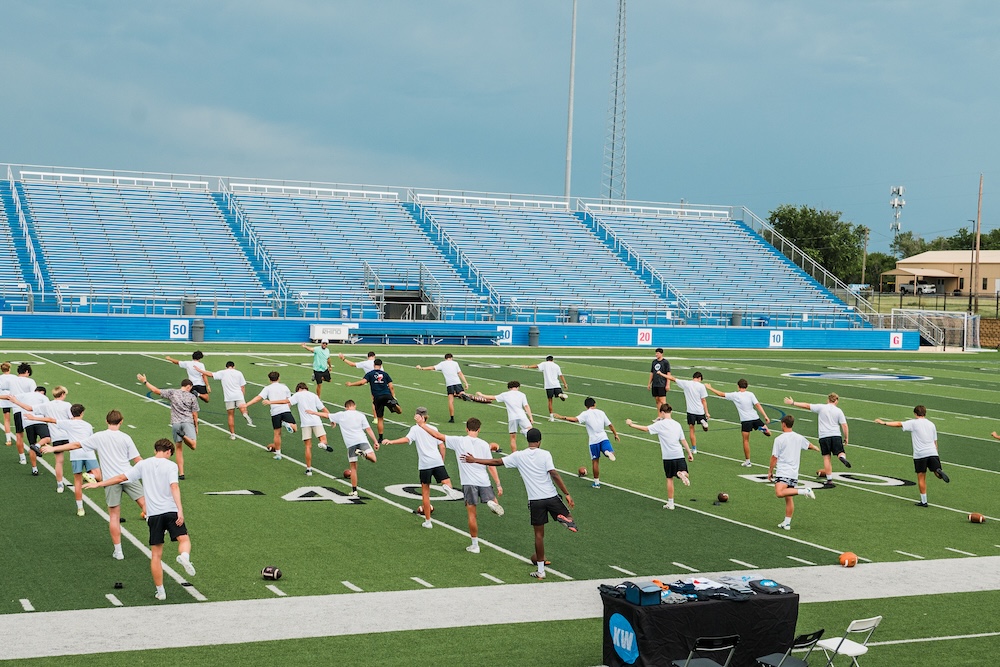
Now that you’ve completed the summer kicking camp circuit and are gearing up for the start of your summer/fall team football practices, we’ve put together a bulleted list of kicking tips to ensure you’re doing everything you can to maximize your confidence and consistency as you approach your first regular season football game! Read on for simple but effective kicking tips to help propel you forward this season – whether you’re starting middle school or your freshman year of high school, fighting for that HS varsity spot, or journeying further into college or professionally, all of what we’ll discuss will inevitably help you perform better this year!
1. Make a Good Impression on your Coaches
The first impression of your coach could also be the last impression he has of you. Will you show up hungry, running through each wind sprint, looking each coach in the eye with attentiveness, show up early and on time for each scheduled meeting, and put a lot of hard work in when no one is watching? Or will you mope around and complain about the heat, turn away when coaches are trying to teach you, look uninterested as others around you are grinding hard for the team, and show up late to practices and meetings? If the latter, you can forget about it right now. Don’t bother reading further because you won’t last a season. But if you’re ready to put in the work, become the best student-athlete you can, and be all in on helping your team win this season, enjoy the following tips. Let’s get to work; let’s get better!
2. Build Trust & Gel with the ‘Kicking Unit’
Ask for extra time with your holder and snapper. Most high school football teams and coaches overlook the importance of providing enough time for the kicker, holder, and snapper to work together, especially in preseason, as you enter the start of your fall football games. This is not only detrimental to your overall results as a unit but can also be a confidence-killer, as you simply don’t have enough time to establish the optimal flow. Whether it’s determing how quickly you need to start your approach steps based on how fast or slow the snapper or holder is, or showing your holder how you prefer the ball to be positioned (location, tilt & lean) on the ground or on your field goal block, and in general building trust to know all three of you are working together and have no doubt you’re pulling weight and doing your best for the team.
All of these questions can’t ever be answered unless the kicking unit is allotted enough time to properly prepare and gel. Having a good (or bad) holder and/or longsnapper can make or break your season. Even more so, lacking or losing confidence is perhaps the greatest detriment to your kicking success. Speak up and ask your coaches for a little extra time to establish that gel with your kicking unit – even if it’s an additional 5 to 10 minutes, 2 times a week for the first 2-3 practice weeks; it will go a long way!
3. Visualization through Video Games
Our students always laugh at camp when I bring this one up, but it’s pretty helpful! One of my college students was in a slump, and I had him download one of those ‘flick kick’ type football kicking / soccer goal shooting games on his iPad. I told him to visualize being there in the game, in the stadium, setting up for that kick, and seeing the ball go through the goalposts. Kick after kick sailing true, through the goalposts, right down the middle. Believe it or not, this helps build confidence and almost tricks your mind into thinking you just kicked all those kicks, and you’ve been there before. You can also do this with one of the college or pro football games (enter practice/training mode) on whatever gaming platform you use. Whether you had a bad practice day, scrimmage, or game, and you’re feeling a little down on yourself or a slight decline in confidence, try this tip, and I think you’ll like the results!
4. Dry Reps
Especially if you haven’t been kicking enough this off-season, or if your leg seems to tire earlier than it should, doing more ‘dry kicks’ or dry reps is a great way to go through the kicking motion without completely taxing your leg and body. A full-swing kick where you make actual impact with your foot to the ball puts a lot of pressure on your leg, particularly the hip flexor and quadriceps muscles, which are very prone to injury as a placekicker. For punters, it’s typically more so the hamstrings. Implementing more dry reps throughout your practice week and practice day can reduce the total volume of necessary kicks, as you’re essentially practicing ‘air kicks’. Don’t, however, do these mindlessly. Be specific with your form and imagine the ball there, making a clean swing mirroring what you would typically do on a real kick. You can reduce the power percentage slightly and say instead of a normal field goal or punt at 80-85% power, do your dry swings at 40-60% power. It’s a great tool to work on your swing path, balance, timing of your guide arm and leg swing, weight transfer, and your follow-through.
5. Creating Streaks
It’s easy to make one kick, but being able to ladder multiple kicks together over a season is a true feat. I’ve found over the years that many kickers, particularly from different camps, are focusing too much on making one big kick, regardless of how many prior attempts they’re given. This will not put you in the best position to excel in a game, which is what ultimately matters the most. It’s great to find success on the kicking camp circuit, but what’s more impressive is implementing all you learn at camp, and then applying it to real-life scenarios, in-game, when the pressure is on and your team needs you the most!
What do I mean by creating a streak? Well, being able to accumulate 8, 9, 10+ made kicks with no misses over 2 or 3 games is a major accomplishment! One simple, and somewhat fun game you can play at practice is by kicking multiple PATs in a row, and just staying there at 20 yards until you connect on 20 in a row. If you miss one at kick #9, for instance, you have to start over again. Now you’ve reached #17 and haven’t missed this time around, with three more to go! Will you start telling yourself ‘only 3 more’, or will you instead focus on the present kick, ONE KICK AT A TIME! As you can imagine, the latter is the way we as kickers (and golfers) typically need to think. Don’t harp on your past kicks, and most certainly don’t start counting your winnings before you’ve cashed out.
If you can make it to 20 kicks in a row, I can almost guarantee that you’ll feel immensely more confident this season, both with your extra points, but also your short kicks. If you have a problem area – for instance, you get nervous on short hash mark kicks, or at 45 yards, you seem to start changing your form, you can play the game on those specific kicks, too. One last note on this section: if you have to restart multiple times and have kicked 40+ kicks, please don’t continue the game at this particular practice session. Wait to try again the next day, or else you risk hurting your leg from over-kicking. Check out a very short blog article from the archives about how you can improve your mental game by bowling.
6. Kick Counter
Provided you’ve been practicing this off-season and summer, you will now start approaching the peak of your kicking volume. Ideally, kick 35-40 total kicks, 2-3 days a week, and 40-45 total kicks 1-2 days a week, for a total of ~5 days a week, including your games or scrimmages. I highly recommend taking a break from kicking at least one day a week, if not two. We tend to only have our fall kicking camps on Sundays in September and October, with the idea that we want our high school students to rest the day after their varsity game to recover properly and not risk injury.
If you’re exclusively a kicker, divvy up most practice days with approximately 85% field goals and only 15% kickoffs. Kickoffs take a lot out of your leg, and we only recommend doing them 2 to 3 days a week. If you handle all three skills – field goals, kickoffs, and punts, or dabble in all 3, pick your priority/most important skill and perhaps spend 50-60% of the time on that, and divide the other two accordingly – perhaps 20-30% for each of those.
Make sure you have a ‘kick counter’ either in your mind, or writing or typing it down. Just like a pitcher in baseball, the manager/coach needs to keep track of how many balls the pitcher has thrown each inning. If they pitch up to 70, 80, or more pitches in a game without sufficient rest beforehand, they could be at severe risk of injury. Don’t make the mistake of overdoing it, which takes us to the next point…
7. Listen to Your Leg
You need to find that harmonious balance of kicking enough, but not overdoing it. As you mature in your kicking and go from beginner to intermediate to hopefully advanced or further, you begin to learn your body and your routine – what works, and what doesn’t work. While certainly there are some generally accepted principles and recommendations for kicking practice and volume, each person is unique and different, and what works for one student might not be ideal for another. Striking a balance on the number of kicks you take each day without going overboard and kicking to the point of exhaustion is critical.
Overkicking creates many problems, namely, you will typically start getting sloppy form as your leg dies out, and obviously, you are exponentially increasing your chances for an overuse injury. While you may set out to practice 45 minutes or 1 hour today, there is absolutely nothing wrong with finishing a little earlier. If you’re not feeling it that day and nothing seems to be going your way, it might make sense to push through and find a way. However, it might be a better idea to punch out for the day and regroup tomorrow. If you keep going and going, and 2 hours later find yourself with a throbbing leg, and nothing to show for except you just blasted 85 kicks one after another out of frustration, you just made a potentially season-changing decision that can set you back for weeks if your body doesn’t properly heal.
Whether you’re going to kicking camps, practicing with your team during the week, training in the off-season, or on the sidelines of a game, be judicious with your kicking volume, listen to your body, and know when to put the brakes on it with the idea of preserving your leg for the long term and staying health. Check out my 5 Most Common Kicking Injuries blog series.
8. Rest & Recovery
Technology & treatments have evolved since I last played high school and college football. Now, with so many treatment options available, you can get back on track faster. Some that I’ve found effective over the years with my own body (after long weekends of coaching / demonstrating kicks and playing golf):
- Rest
- Ice, Compression, and Elevation
- Cryotherapy
- Tens Unit / E Stim Machine
- Infrared Sauna
- Infrared Heating Pad
- Muscle Rubs, balms, and ointments
R.I.C.E. (rest, ice, compression, elevation) has been around for decades, and it remains the go-to recommendation of most sports medicine professionals, physical therapists, and athletic trainers. Explore our recommended Amazon products, including a tens unit, infrared heating pad, and muscle rubs, along with accessories like kicking nets and training tools.
9. Dress Rehearsal
Train at your stadium field once or twice this summer/fall and go through a pre-game routine to feel more confident when the lights come on later this season. Doing it now will help you rehearse and practice, so that when the time comes, it’ll feel like you’ve already been there, and your nerves will be kept much more at bay.
If you’ve found this article helpful, consider ordering Coach Brent’s popular kicking and punting instructional videos and books from the official Kicking World shop for even more great kicking tips and a step-by-step process on mastering the kicking game.
About the Author
At the time of this article (August 2025), Coach Brent Grablachoff has been running one of the largest and most well-known kicking camps for over 18 years now. He and his staff travel to over 35 states in the U.S. every camp season, bringing the best instruction, drills, and competitions to aspiring kickers & punters from coast to coast.